



Address: No. 92, Xidazhi Street, Nangang District, Harbin



JOIN-USHIT sincerely invite talents from both home and aproad to join in the new course of constructing first-class universities. |
A distributed multi-parameter monitoring system based on a single optical fiber — developed by Professor Dong Yongkang and his team at the School of Astronautics, Harbin Institute of Technology (HIT) — has been successfully deployed for real-world monitoring and early potential warning of threat events in long-distance oil and gas pipelines. The system is a key outcome of National Key Research and Development Program of China, under the project “Development of a Multi-Parameter Threat Event Monitoring Sensor System Based on Optical Fiber.” A review committee convened by PipeChina concluded that the system meets the requirements for field deployment.
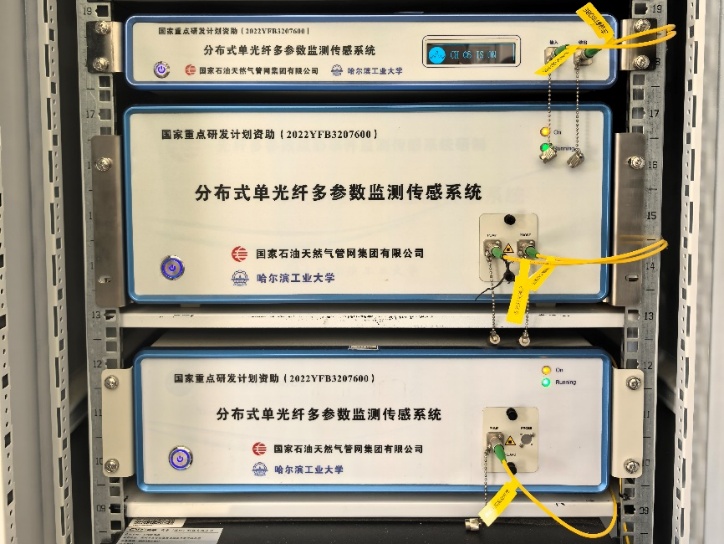
The team’s distributed single optical fiber multi-parameter monitoring system.
Oil and gas pipelines form a vital part of the national energy supply network. Ensuring their safe and efficient operation is essential to safeguarding national energy security. China has established an extensive backbone network stretching across regions and connecting overseas routes. However, pipelines are spread over vast and complex terrains — often running through densely populated and environmentally diverse areas — making them susceptible to a variety of safety incidents. Traditional patrol and video-based monitoring methods suffer from blind spots and limited real-time capability, falling short of the modern demands for early warning and active control. Distributed optical fiber sensing technology is intrinsically safe, resistant to electromagnetic interference, capable of continuous spatial measurement and suitable for long-distance monitoring, making it one of the most appropriate and efficient technologies for real-time pipeline safety monitoring.
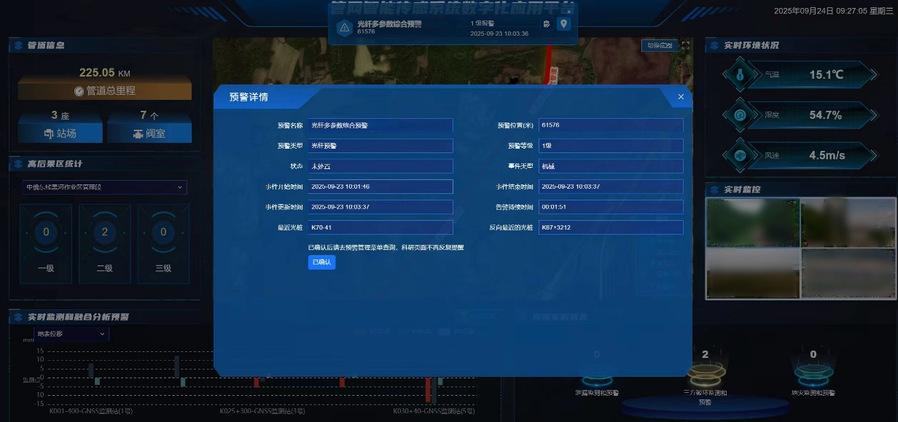
The system successfully detected and alerted to a third-party threat incident on the pipeline.
To address the urgent need for threat detection in critical national infrastructure, Professor Dong’s team proposed a multi-dimensional distributed sensing scheme that integrates Brillouin and Rayleigh scattering mechanisms. Through effective separation of the dual-scattering signals, the system enables simultaneous measurement of temperature, strain, vibration and acoustic parameters along a single optical fiber.

Head of the research team Professor Dong Yongkang at the pipeline site.
Supported by the National Key Research and Development Program of China and the National Natural Science Foundation of China, Professor Dong’s team has long been committed to the research, application and industrialization of high-performance distributed optical fiber sensing technologies. Their work has produced a full-chain set of achievements — spanning cutting-edge fundamental research, high-performance instrument development and large-scale industrial deployment. The team’s innovations have already been applied in several major national strategic projects, providing strong technical support for safeguarding China’s energy security.
一审-宋子畅
二审-陈东萍
三审-董永康
Address: No. 92, Xidazhi Street, Nangang District, Harbin