



Address: No. 92, Xidazhi Street, Nangang District, Harbin



JOIN-USHIT sincerely invite talents from both home and aproad to join in the new course of constructing first-class universities. |
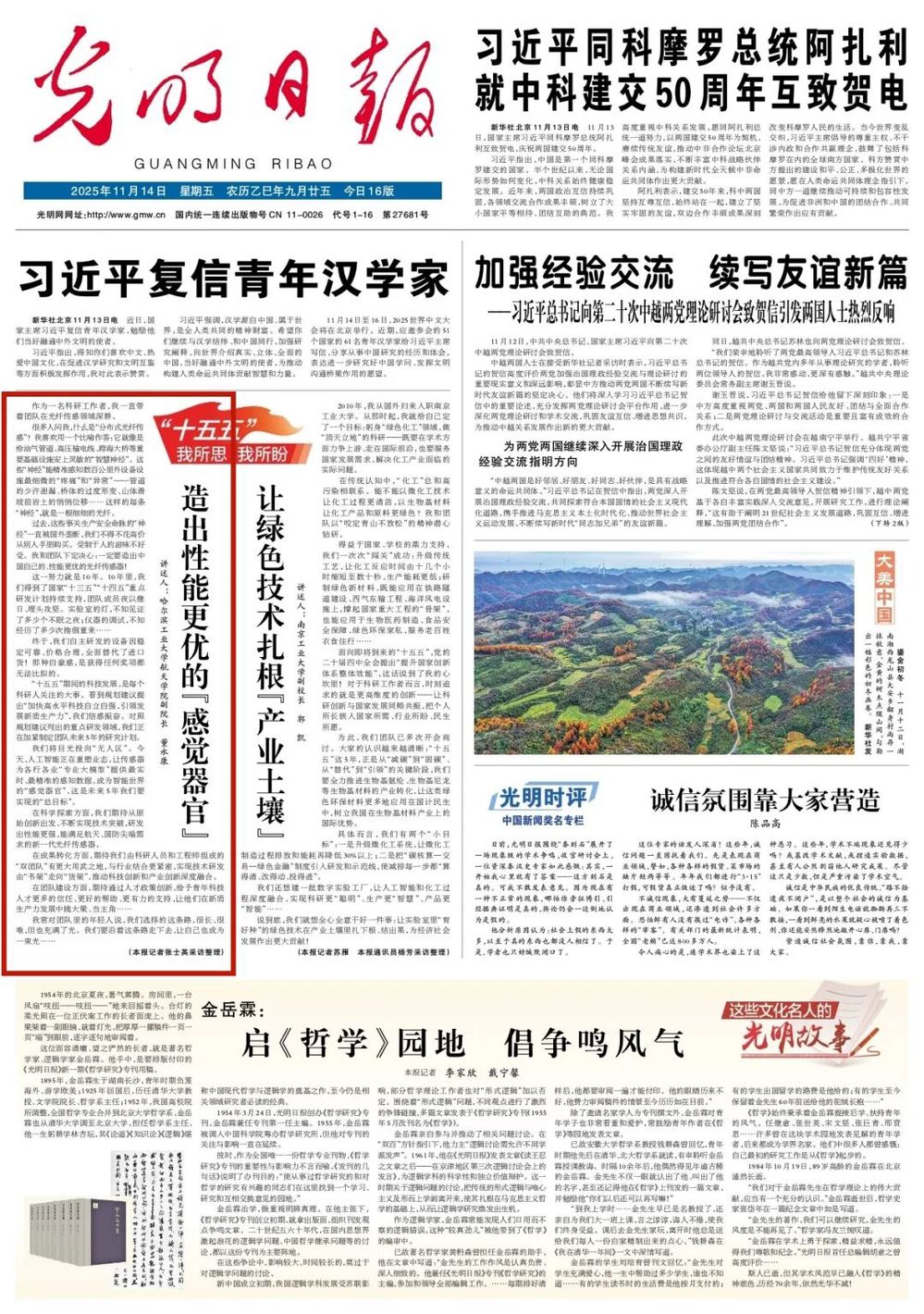
Beijing, 14 November — The front page of GuangMing Daily today carried, in its special column “What I Think and Hope for the 15th Five-Year Plan”, a signed article by Professor Dong Yongkang, Vice Dean of the School of Astronautics, entitled “Creating Higher-Performance ‘Sensory Organs’”.
In the piece, Professor Dong reviews how his research team has broken foreign monopolies in distributed optical fiber sensing and achieved a new leap in technological capability. He also sets out their vision and roadmap for the 15th Five-Year Plan period: upgrading optical fiber sensors into intelligent “sensory organs” that empower industries across the board and contribute to the development of new quality productive forces.
Creating Higher-Performance ‘Sensory Organs’
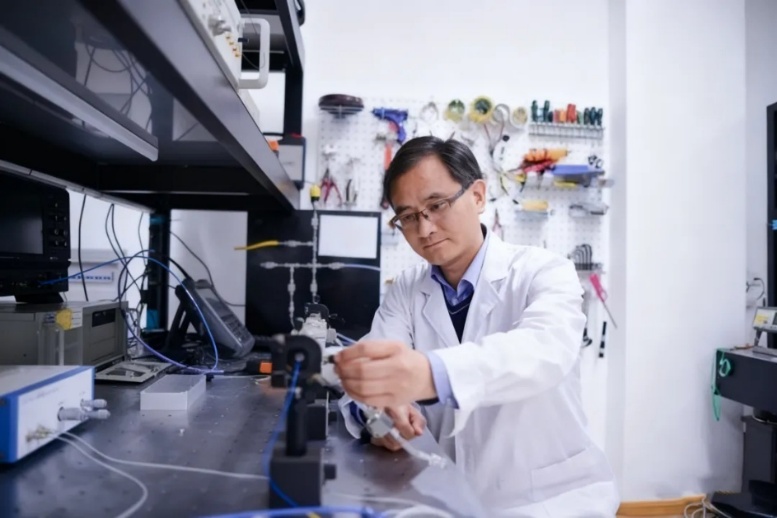
As a scientific researcher, I have long been leading my team in deep, sustained work in the field of optical fiber sensing.
Many people ask me: what is distributed optical fiber sensing? I used to answer with a metaphor: it is like equipping critical infrastructure — oil and gas pipelines, high-voltage transmission lines, sea-crossing bridges — with a network of highly sensitive “smart nerves”. These “nerves” can accurately sense the faintest stress or faults in equipment hundreds of kilometers away — a slight leak in a pipeline, excessive deformation of a bridge, or the almost imperceptible movement of rock and soil before a landslide. Each one of these “nerves” is, in fact, a single slender strand of optical fiber.
In the past, these “nerves” — the very lifelines of production safety — were long monopolized by foreign suppliers, and we had no choice but to pay high prices to buy from others. The feeling of being so constrained is not an easy one. My team and I therefore resolved that we must build China’s own optical fiber sensors, with even better performance.
That resolve has guided a decade of effort. Over the past ten years, with continuous support from the National Key Research and Development Program of China under the 13th and 14th Five-Year Plan periods, our team has worked around the clock, burying itself in one hard problem after another. The lights in our laboratory have witnessed countless sleepless nights; our instruments have gone through endless cycles of adjustment, tearing down and starting again.
At last, the equipment we developed independently has proved so stable, reliable and competitively priced that it now fully replaces imported systems. The sense of pride that brings is beyond anything that any award could offer.
For every researcher, the direction of science and technology in the 15th Five-Year Plan period is a matter of great concern. When we read in the planning proposals the call to “accelerate the attainment of high-level self-reliance and strength in science and technology, and lead the development of new quality productive forces”, we were deeply encouraged. Taking the priority research fields listed in those proposals as our guide, we are now drawing up our team’s research roadmap for the next five years — and setting our sights firmly on the scientific no-man's-land.
Today, artificial intelligence is reshaping entire industries. Our overarching goal for the next five years is this: to enable sensors to provide the most real-time, most accurate data to industry-specific large AI models across different sectors, so that optical fiber sensors can truly become the “sensory organs” of an intelligent world.
On the side of scientific exploration, we aim to start from original innovation, keep pushing through technical frontiers, and develop a new generation of high-performance optical fiber sensors capable of meeting the cutting-edge needs of aerospace.
On the side of translating research into real-world impact, we hope that our “dual-team” model — bringing together researchers and engineers — can play an even greater role, working in much closer partnership with industry. Our aim is to move scientific and technological achievements from the “book shelf” to the “shop shelf”, and to drive deep integration between scientific innovation and industrial innovation.
On the side of team-building, we hope that through innovative talent policies we can place greater trust in young scientists, provide them with better help and stronger support, and enable them to shoulder major responsibilities and take center stage in developing new quality productive forces.
I often say to the younger members of our team: the path we have chosen in scientific research is long and difficult, but it is also filled with light. We must keep moving forward along this path — and strive to become a beam of light that illuminates the way ahead.
一审-宋子畅
二审-陈东萍
三审-董永康
Address: No. 92, Xidazhi Street, Nangang District, Harbin