



Address: No. 92, Xidazhi Street, Nangang District, Harbin



JOIN-USHIT sincerely invite talents from both home and aproad to join in the new course of constructing first-class universities. |
The 2025 China International Travel Mart (CITM) was recently held grandly in Haikou, Hainan. As a national-level tourism industry event, the CITM serves not only as a vital window to showcase cultural and tourism resources from various regions but also as an innovative platform promoting the integration of technology + culture and tourism. At this year's exhibition, the Heilongjiang delegation, led by the Provincial Department of Culture and Tourism, organized eight municipal (prefectural) cultural and tourism bureaus and over ten key enterprises to participate, collectively presenting Heilongjiang's latest achievements in the integration of culture and technology.
The 2025 China International Travel Mart (CITM) was recently held in Haikou, Hainan. As a national tourism event, CITM serves as both a key platform for showcasing regional cultural and tourism resources and a hub for exploring how technology can be integrated into the sector. At this year’s exhibition, the Heilongjiang delegation, led by the provincial Department of Culture and Tourism, brought together cultural and tourism bureaus from eight cities and prefectures, along with more than ten leading enterprises, to present the province’s latest progress in combining culture with technology.
The synthetic colored diamonds and diamond rings, independently developed by the Infrared Films & Crystal Team, were featured in the technology exhibition area of the Heilongjiang delegation. As key technological and cultural innovations highlighted by Harbin Institute of Technology, these sparkling diamonds are not only symbols of beauty but also the crystallization of cutting-edge materials science. They attracted admiration from exhibitors and visitors representing 101 countries and regions, and received significant coverage from Heilongjiang's official cultural tourism channels and multiple media outlets, becoming a standout example of how technology empowers cultural tourism consumption within the delegation.
Synthetic colored diamonds and diamond rings developed by the Infrared Films & Crystal Team were showcased in the Heilongjiang delegation’s technology exhibition area. Highlighted by Harbin Institute of Technology, these pieces not only display their visual appeal but also reflect advances in materials science. They drew strong interest from exhibitors and visitors from 101 countries and regions and received wide coverage from Heilongjiang’s cultural tourism platforms and other media outlets, standing out as an example of how technology can enhance cultural tourism experiences.
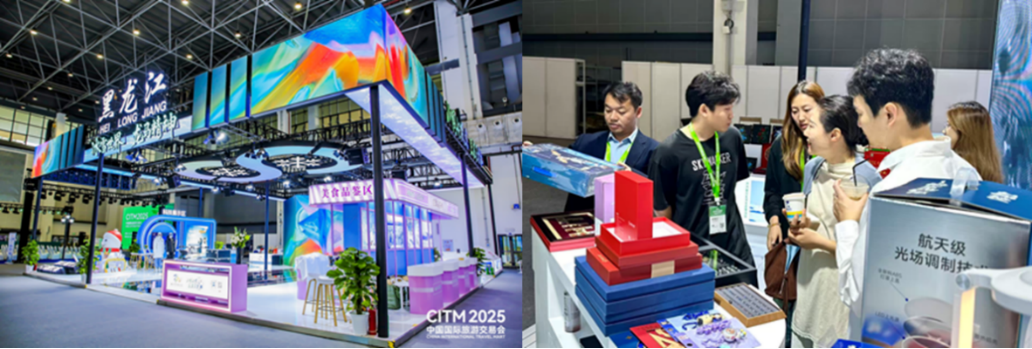
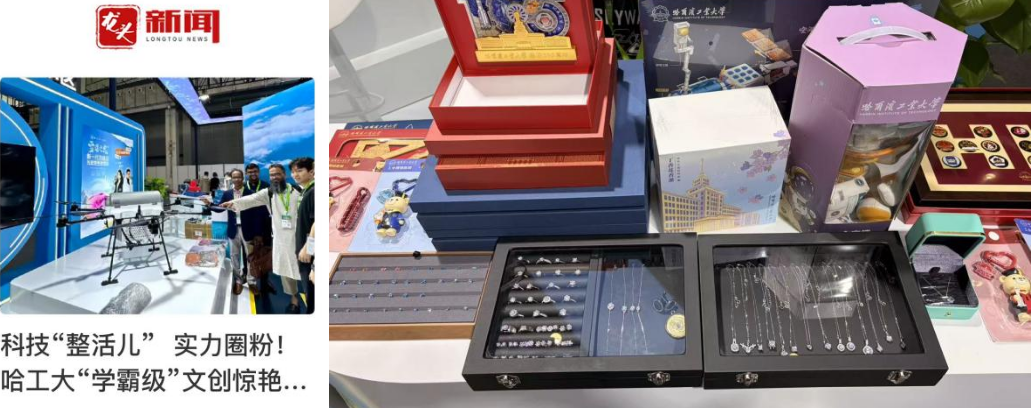
Diamond products created by the Infrared Films & Crystal Team on display at CITM
The Infrared Films & Crystal Team has long been dedicated to research on single-crystal diamond materials and their applications in fields such as heat sinks, semiconductors, optical windows, and quantum technologies. The colored diamond series exhibited this time are innovative products derived from the team's pioneering breakthroughs in the field of single-crystal quantum diamond materials.
The Infrared Films & Crystal Team has long focused on research into single-crystal diamond materials and their applications in areas such as heat dissipation, semiconductors, optical windows, and quantum technologies. The colored diamond series on display is based on the team’s recent advances in single-crystal quantum diamond materials.
Specifically, the blue color in these diamonds originates from precisely controlling the concentration of carbon atom vacancies (GR1 color centers) within the diamond lattice. This color center absorbs near-infrared light within the visible light wavelength range, creating the distinctive blue hue through the principle of color compensation. Compared to natural blue diamonds, synthetic blue diamonds offer significant advantages in color consistency, customizability, and sustainability. On one hand, precise control over lattice defects enables high stability in color saturation and uniformity, overcoming the scarcity and uneven coloration limitations of natural blue diamonds. On the other hand, the growth process eliminates the need for mining, not only reducing environmental impact but also allowing flexible responses to design requirements, achieving controllable gradients from delicate sky blue to deep indigo across a broader color spectrum. This truly realizes color freedom empowered by technology.
Specifically, the blue color in these diamonds originates from precisely controlling the concentration of carbon atom vacancies (GR1 color centers) within the diamond lattice. The color centers absorb portions of near-infrared light within the visible spectrum, and through a process of color compensation, give the diamonds their distinctive blue appearance. Compared with natural blue diamonds, synthetic ones offer greater consistency, flexibility, and sustainability. Precise control over these structural features ensures uniform color and stable saturation, avoiding the rarity and uneven tones often found in natural stones. At the same time, they are produced without mining, reducing environmental impact and allowing designers to create a wide range of shades, from pale sky blue to deep indigo.
Pink diamonds, meanwhile, originate from nitrogen-vacancy (NV) color centers. These centers are not only core carriers in current room-temperature solid-state quantum systems but also possess controllable and coherent quantum spin states, providing a key physical platform for quantum computing and quantum sensing. Synthetic pink diamonds enable continuous color customization from light cherry blossom pink to vibrant rose pink, while completely avoiding the environmental and ethical burdens associated with natural mining.
Pink diamonds, meanwhile, derive their color from nitrogen-vacancy (NV) centers in the crystal lattice. These defects are important components in room-temperature solid-state quantum systems because their quantum spin states can be precisely controlled, making them useful for applications such as quantum computing and quantum sensing. Synthetic pink diamonds can be produced in a range of shades, from soft cherry-blossom pink to vivid rose, while avoiding the environmental and ethical concerns associated with mining natural diamonds.
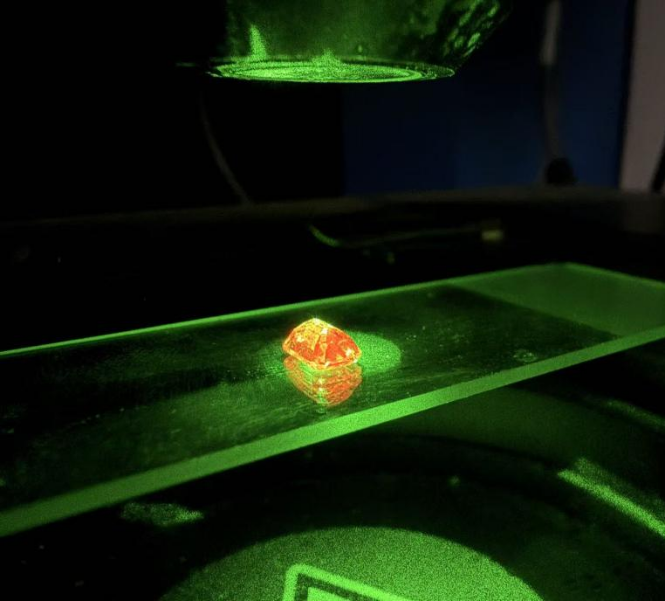
Pink diamonds, based on the NV color center solid-state quantum system, luminesce when excited by a green laser.
Through the controllable preparation and stable integration of such color centers, our team has not only achieved precise color construction in colored diamonds but also demonstrated the technological capability to transition quantum material systems from the laboratory to consumer applications. The diamond products manufactured by the team all achieve VVS clarity grade and feature cuts meeting the highest standards of 2EX to 3EX, truly integrating quantum technology into brilliant jewelry.
By precisely controlling and incorporating these color centers, the team has achieved consistent, tailored coloration in synthetic diamonds while also showing how quantum materials can be applied beyond the laboratory. All of the team’s diamond products reach VVS clarity and are cut to high standards (2EX to 3EX), combining quantum technology with fine jewelry design.
Furthermore, the team has mastered unique color customization and gradient technologies, enabling the stable synthesis of artificial colors that are rare or non-existent in natural diamonds. This has allowed the establishment of an independent and controllable closed-loop production process capable of synthesizing colored diamonds in hues seldom found in nature, such as pink, blue, green, yellow, and black series.
The team has also developed advanced techniques for color customization and gradients, making it possible to reliably produce shades that are rare or not found in natural diamonds. This has enabled a fully controlled production process for creating colored diamonds across a wide range of hues, including pink, blue, green, yellow, and black.
Leveraging its proprietary color customization and gradient technologies, the team has established a complete, controllable closed-loop production system. Moving forward, it will launch more technology-empowered diamond products, includingBasic: Colorless Synthetic Diamonds, Rainbow Colored Synthetic Diamonds and Rainbow Gradient Synthetic Diamonds.
Building on its proprietary color customization and gradient technologies, the team has developed a fully controlled, end-to-end production system. It plans to introduce additional technology-driven diamond products, including basic colorless synthetic diamonds, as well as “rainbow” colored and gradient designs.
Basic Colorless Synthetic Diamonds:
These products feature D-E color, VVS clarity grade. The primary shape is round brilliant, with fancy shapes as supplements. The cut meets the highest 3EX standard. They are categorized by diamond weight into: <Rainbow | Star> series (0.1~0.5 ct); <Rainbow | Eternal Shine> series (0.5~2.5 ct); <Rainbow | Dome> series (2.5~10 ct).
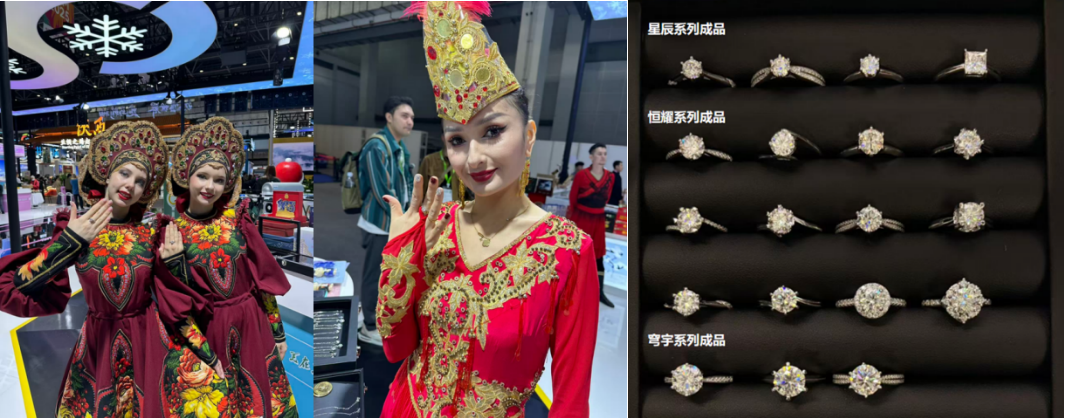
Colorless lab-grown diamond products manufactured by the team
Rainbow Colored Synthetic Diamonds:
These products feature a range of colors achieved through special processes, including artificially synthesized colors that are extremely rare or non-existent in natural diamonds. They have VVS clarity grade, primarily fancy shapes, and cuts meeting the highest 2EX standard. Diamond weight ranges from 1 to 3 ct. Main color series include: Pink, Blue, Green, Yellow, Black.
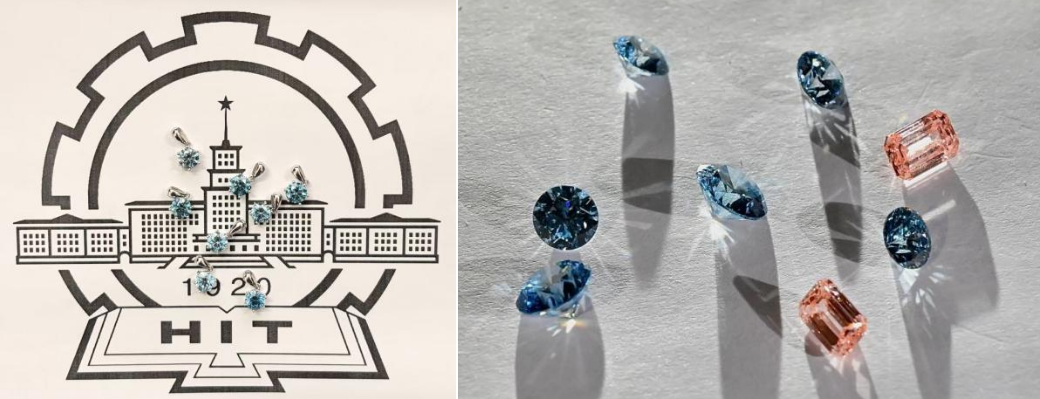
Colored synthetic diamond products manufactured by the team
Rainbow Gradient Synthetic Diamonds:
These products feature a range of colors achieved through the patented technology outlined in A Method for Preparing CVD Blue Gradient Diamonds Based on Lead-Type Electron Irradiation Carriers. They have VVS clarity grade, primarily fancy shapes, and cuts meeting the highest 2EX standard. Diamond weight ranges from 1 to 3 ct. Main color series include: Pink gradient, Blue gradient.
The technical method involved in this patent innovatively places diamond rough in a specially designed electron irradiation carrier, enabling precisely irradiation treatment on specific regions of the crystal. This process effectively introduces a gradient distribution of lattice defects, thereby forming a blue transition effect ranging from shallow to deep within the diamond. This technology not only significantly enhances the artistic expressiveness and creative freedom of colored diamonds in jewelry design but also provides a reliable preparation path for achieving diamond products with complex color structures and visual layers, further expanding the application space of lab-grown diamonds in the high-end custom jewelry sector.
This patented technique involves placing rough diamonds in a specially designed holder for electron irradiation, allowing specific areas of the crystal to be treated with precision. The process creates a controlled gradient of lattice defects, producing a blue color that shifts from lighter to deeper tones within the diamond. The result expands design possibilities for colored diamonds, enabling more intricate color effects and layered visual appearance. It also provides a reliable way to produce diamonds with complex color structures, supporting the use of lab-grown diamonds in high-end custom jewelry.
一审-宋子畅
二审-陈东萍
三审-智喜洋
Address: No. 92, Xidazhi Street, Nangang District, Harbin