



Address: No. 92, Xidazhi Street, Nangang District, Harbin



JOIN-USHIT sincerely invite talents from both home and aproad to join in the new course of constructing first-class universities. |
From April 17 to 19, the 4th International Workshop on Vibration Energy Harvesting and Control (IWVEHC 2026) was held in Harbin. Jointly organized by the School of Astronautics at Harbin Institute of Technology and the Heilongjiang Society of Vibration Engineering, the workshop brought together more than 100 experts, scholars, and early-career researchers from 49 universities and research institutes across eight countries, including China, Poland, Egypt, Malaysia, Russia, Morocco, Guinea, and Bangladesh. Participants engaged in in-depth discussions on the latest advances, emerging trends, and major scientific challenges in vibration energy harvesting and vibration control.
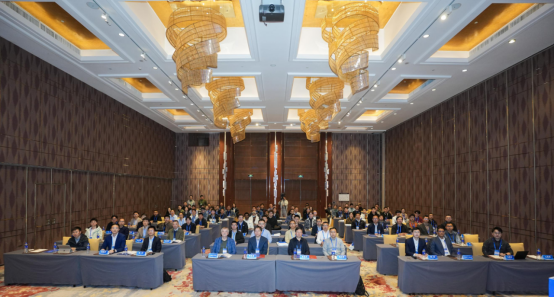
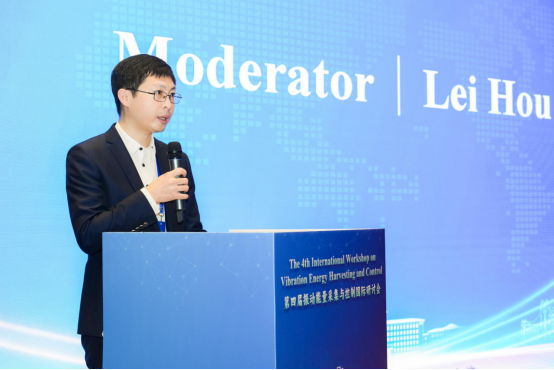
The opening ceremony was held on the morning of April 18 at the Aoluguya Hotel and was chaired by Professor Hou Lei of Harbin Institute of Technology, Co-Executive Chair of the workshop.
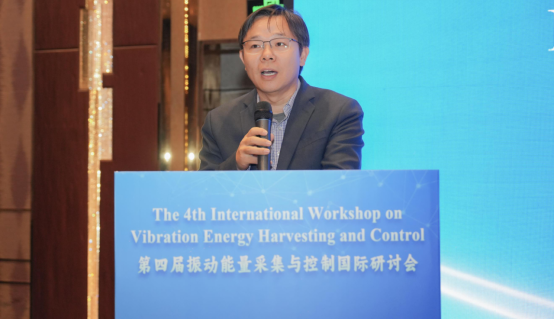
Professor Zhou Shengxi, Conference Chair and Deputy Secretary-General of the Chinese Society for Vibration Engineering, delivered the opening remarks on behalf of the organizing committee. He expressed sincere appreciation to the conference team at Harbin Institute of Technology for their careful preparation and reviewed the development of the workshop series. First launched at Northwestern Polytechnical University in 2023, the workshop has since been hosted by Shenzhen University and Zhengzhou University, with this year’s event held at Harbin Institute of Technology. He noted that the workshop has continued to grow in scale and academic influence, becoming an important platform for the development of the research community in this field. He encouraged participants to use the workshop as an opportunity to exchange ideas, foster innovation, strengthen collaboration, and pursue new breakthroughs in related research areas.
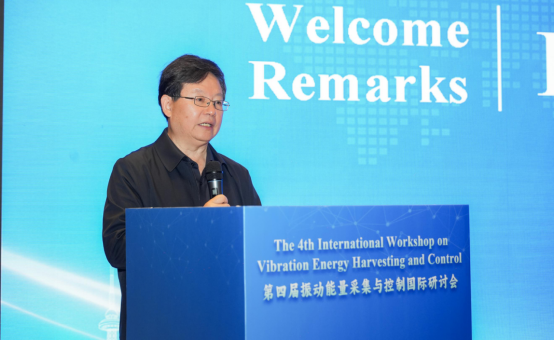
Professor Cao Dengqing of the School of Astronautics at Harbin Institute of Technology also delivered opening remarks. He welcomed participants from China and abroad and reviewed the century-long development of vibration energy harvesting and control technologies. He emphasized the important role these technologies play in the interdisciplinary development of engineering mechanics and their broad range of applications. Addressing young scholars, he encouraged them to pursue cutting-edge fundamental research while remaining engaged with real-world engineering challenges, contributing original innovations to industrial advancement and national strategic priorities.
During the morning plenary session, six keynote speakers presented research on frontier topics including acoustic metamaterials, biomechanical energy harvesting, and nonlinear dynamics. Professor Yang Tianzhi of Northeastern University delivered a presentation titled “Twist Moire Acoustic Metasurface,” introducing breakthrough research on twisted moire acoustic metasurfaces that overcomes the symmetry constraints of conventional acoustic structures and opens new possibilities for acoustic wave control and sensing. Professor Li Qingguo of Queen’s University, Canada, presented “Wearable Biomechanical Devices: From Energy Harvesting to Improving Walking Efficiency,” discussing the integrated design of wearable biomechanical systems for energy harvesting and gait enhancement, with implications for rehabilitation technologies. Professor Grzegorz Litak of Lublin University of Technology, Poland, spoke on “Nonlinear Energy Harvesting Using an Amplitude Amplifier,” highlighting innovative applications of nonlinear dynamics in broadband vibration energy harvesting. Professor Nasser A. Saeed of Menoufia University, Egypt, presented “Accuracy of the Detuned Multiple Scale Perturbation Method versus the Traditional Multiple Scale Method,” sharing recent advances in nonlinear vibration analysis using the detuned multiple-scale perturbation method. Professor Zou Hongxiang of Hunan Institute of Engineering delivered a presentation titled “Biomechanical Energy Harvesting Systems with Mechanical Intelligence: Design and Applications,” showcasing innovative intelligent structures for harvesting energy from human motion in a range of application scenarios. Professor Kuang Yang of Central South University presented “Energy Harvesting and Self-Powered Sensing Systems for Intelligent Railway Infrastructure,” introducing self-powered sensing technologies for intelligent railway systems and their potential applications in smart rail operation and maintenance.
The seven keynote presentations in the afternoon focused on vibration control technologies, engineering applications, and interdisciplinary innovation. Associate Professor Wang Yilong of Harbin Institute of Technology presented “Dynamics Design of Intelligent Systems for Vibration Control under Broadband and Variable-Frequency Excitations,” introducing advances in intelligent vibration control and ambient micro-energy harvesting. Dr. Li Chong of the University of Hong Kong delivered a presentation titled “Research on Vibration-Coded Metamaterial Structure Design and Sensing Devices,” sharing research on vibration-coded metamaterial structures and sensing devices for helicopter transmission fault monitoring. Associate Professor Sun Shupeng of Shandong University presented “Nonlinear Vibrations and Control of Thin-Walled Multifunctional Structures: Challenges and Research Progress,” providing an overview of recent advances in nonlinear vibration and control of thin-walled multifunctional structures for aerospace applications. Associate Professor Wu Zhijing of Harbin Engineering University spoke on “Research on Vibration Isolation Structures and Their Engineering Applications,” introducing new vibration isolation structures designed for low-frequency broadband vibration reduction. Professor Wang Biao of Sichuan University presented innovative research titled “A Fully Self-Powered Digital Wearable System for the Auxiliary Treatment of Plantar Fasciitis,” integrating vibration energy harvesting technologies with wearable therapeutic systems. Associate Professor Niu Muqing of Harbin Institute of Technology, Shenzhen, delivered a presentation on “Boundary Condition Adjustment of Compliant Mechanisms for Quasi-Zero-Stiffness Vibration Isolation,” introducing methods for improving the engineering adaptability of low-frequency vibration isolation systems. Research Professor Li Xin of Harbin Institute of Technology presented “Vibration-Powered IoT under Unavoidable Power Outages: From Transient Harvesting to Intermittent Computing,” exploring vibration-powered Internet of Things systems designed to operate during power outages and supporting future large-scale applications of battery-free sensing technologies.
The workshop provided a high-level platform for academic exchange and collaboration among researchers in vibration engineering from China and abroad. It also promoted interdisciplinary collaboration across mechanics, energy, materials science, artificial intelligence, aerospace engineering, and rail transportation, helping to clarify future directions for the field. The event is expected to contribute to advances in fundamental theory, key technologies, and talent development in vibration energy harvesting and control, while supporting China’s broader goals in scientific and technological innovation and national strategic development.
The keynote sessions were chaired by more than ten experts and scholars in the field, including Hou Lei, Mei Xutao, Zhou Shengxi, Wang Yilong, Qin Weiyang, Zou Hongxiang, Wang Junlei, Qin Zhichang, Lai Zhihui, Liu Chaoran, Hu Guobiao, Yu Bensong, and Wen Binrong. Discussions throughout the workshop were active and engaging.
一审:宋子畅
二审:陈东萍
三审:智喜洋
Address: No. 92, Xidazhi Street, Nangang District, Harbin