



Address: No. 92, Xidazhi Street, Nangang District, Harbin



JOIN-USHIT sincerely invite talents from both home and aproad to join in the new course of constructing first-class universities. |
Recently, Professor Sun Jianfeng's team from our institute has achieved significant research progress in the field of single-photon detection. The related research findings were published in Optica, an academic journal under the Optical Society of America, under the title Dynamic motion-blur suppression and super-resolution localization of UAV targets using single-photon LiDAR under ultra-low SNR. This research achievement enhances the detection and tracking capabilities of single-photon LiDAR for unmanned aerial vehicles (UAVs) in low-altitude environments, provides important technical support for the fine-grained perception and safety supervision of low-altitude airspace, and helps promote the further development of single-photon sensing technology in the fields of low-altitude monitoring and intelligent perception.
Relying on its extremely high photon-level detection sensitivity, single-photon LiDAR has demonstrated immense potential in long-range target perception. However, when facing dynamic UAV targets at low altitudes, single-photon LiDAR encounters a severe fundamental physical bottleneck: the low signal-to-noise ratio (SNR ≤ 0 dB) and long-distance conditions require the system to undergo long integration times to accumulate effective echo photons; but the coupling of the UAV's rapid movement and the detector array's dead-time effect results in traditional time-domain integration yielding only a blurred average or weighted trajectory. This motion-blur effect severely destroys the system's spatial resolution, making target detection and localization results highly unreliable, and has become a major obstacle to the practical application of single-photon detection technology in low-altitude monitoring.
In response to this challenge, Professor Sun Jianfeng's team proposed a Five-Dimensional Motion-aware Reconstruction (5D-MR) photon computational imaging method. This scheme jointly utilizes the temporal domain (time-of-flight), spatial domain (row and column position), photon count, and frame sequence features of triggered photon events to perform five-dimensional collaborative modeling. It breaks through the physical limits of mutual constraint between spatial resolution and temporal resolution caused by the detector's dead time and the target's high dynamics. Combined with spatiotemporal trajectory prediction of photon events across pixels and sub-pixel interpolation technology, it achieves precise compensation for motion blur and super-resolution localization. To validate the theory and algorithm, the research team independently developed a fully domestically produced single-photon LiDAR prototype. Under extremely sparse conditions with an SNR as low as -8.97 dB and an average of only 0.3550 effective photons per pixel, they achieved motion-blur suppression and super-resolution position reconstruction for a dynamic UAV at a distance of 1.8 km. The angular localization accuracy is better than 0.01°, and the size estimation error is less than 0.02 meters. Compared with traditional methods, this technology achieves a leap of nearly two orders of magnitude in localization accuracy and increases the detection threshold of single-photon LiDAR by nearly 9 dB.
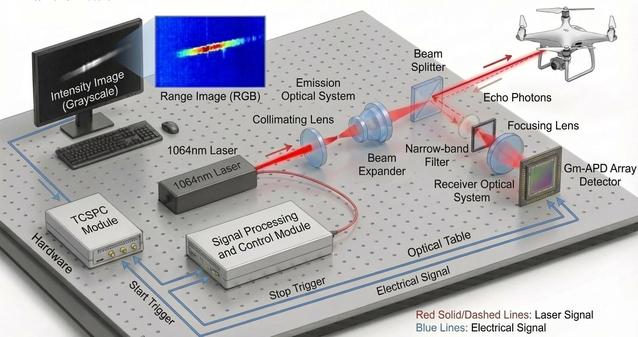
Figure 1: Principle of dynamic UAV detection using single-photon LiDAR
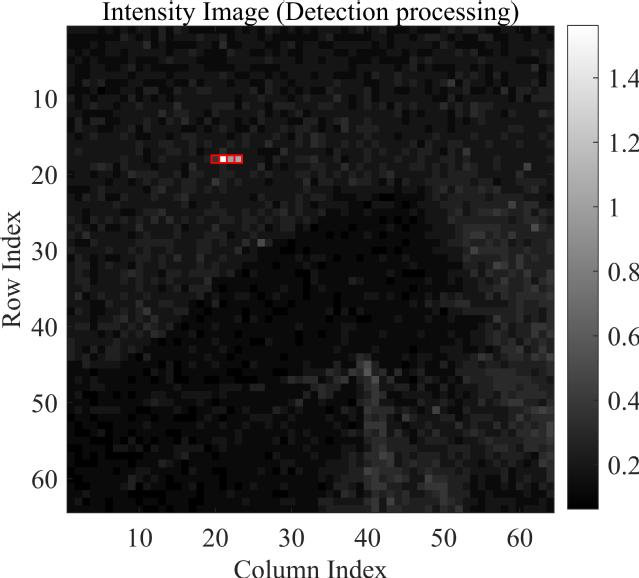
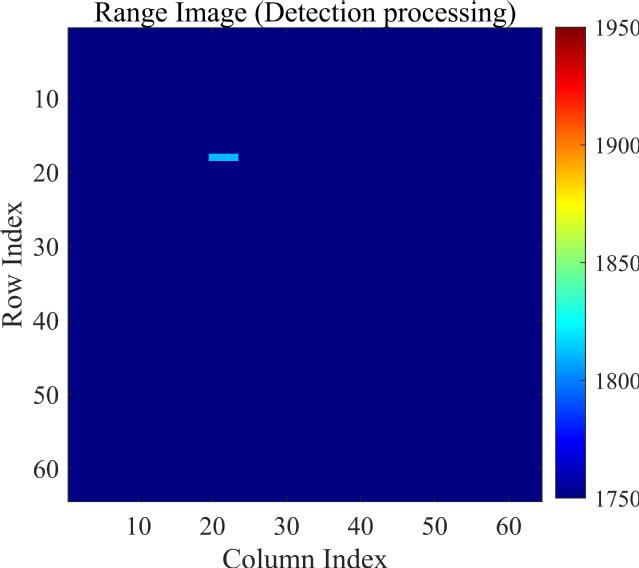
Figure 2: Single-photon LiDAR imaging results based on traditional reconstruction methods
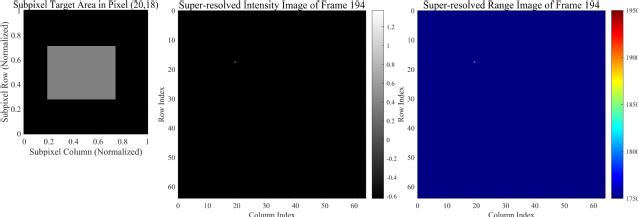
Figure 3: Super-resolution reconstruction results after 5D-MR processing proposed by the research team
Harbin Institute of Technology is the sole corresponding institution for the paper. Professor Sun Jianfeng from our institute is the sole corresponding author, PhD student Guo Dongfang is the first author, and Associate Researcher Zhou Xin is the second author. This research was supported by the National Natural Science Foundation of China.
Paper link: https://doi.org/10.1364/OPTICA.581370
一审:宋子畅
二审:陈东萍
三审:智喜洋
Address: No. 92, Xidazhi Street, Nangang District, Harbin