



Address: No. 92, Xidazhi Street, Nangang District, Harbin


JOIN-USHIT sincerely invite talents from both home and aproad to join in the new course of constructing first-class universities. |
At 11:21 Beijing time on August 25, 2026, the “Harbin” satellite, the fourth satellite in the China Youth Science Popularization Satellite Project and hereinafter referred to as Bayi-04, was launched aboard a Long March-6C launch vehicle from the Taiyuan Satellite Launch Center. HIT SOA’s Lilac Student Micro-Nano Satellite Team was responsible for the satellite’s overall development, while the High School Affiliated to HIT served as the lead developer. The satellite successfully entered its designated orbit, and the launch mission was successfully completed.
The launch was smooth and fully controllable throughout, and the mission proceeded successfully.. At 11:36, Bayi-04 successfully separated from the launch vehicle andwas accurately inserted into its designated orbit The ground telemetry, tracking, and command system successfully acquired the satellite’s telemetry signal. The satellite is operating normally in orbit, with all parameters within normal ranges. Its solar arrays deployed successfully, and it entered three-axis Sun-pointing mode.
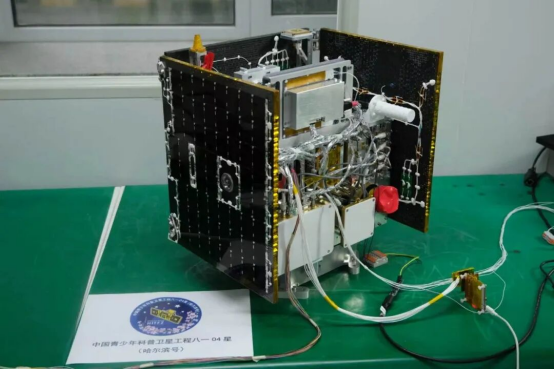
Bayi-04 satellite
Bayi-04 weighs 18.7 kg and is the fourth satellite in the China Youth Science Popularization Satellite Project. Its core functions are aerospace science education and hands-on space science activities for young people. The China Aerospace Science and Technology International Exchange Center provides overall coordination for the satellite project. The development team consists of HIT SOA’s Lilac Student Micro-Nano Satellite Team and the Bayi-04 Middle School Student Experiment Team. The Lilac team is responsible for key engineering work including system-level satellite design, core system development, and satellite-level integration and testing, while the High School Affiliated to HIT is responsible for carrying out a structured program of hands-on aerospace science outreach activities for young people in Harbin. The satellite carries a range of science outreach payloads, including an educational display, a high-definition camera, a miniature monitoring camera, a polarization observation camera, an amateur radio repeater, and an AI experimental payload developed by the School of Computer Science and Technology. While in orbit, it will conduct space-based science outreach experiments and activities, including space photography, imaging with the monitoring camera, polarization observations, and space-to-ground communications,giving young people an immersive experience of the appeal of aerospace and an opportunity to explore the mysteries of space.
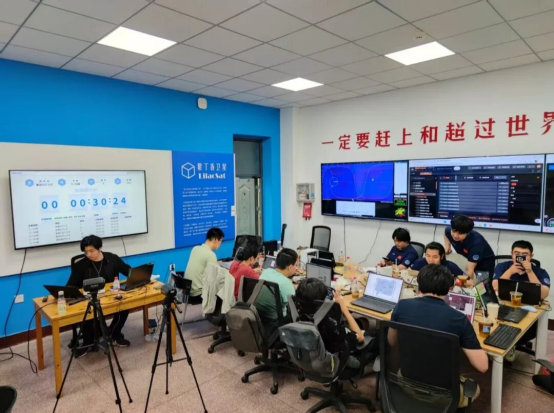
Bayi-04 flight control site
During the development of Bayi-04, the team’s faculty and students drew on HIT SOA’s academic expertise and research facilities and maintained a rigorous, cautious, and detail-oriented approach throughout the project. They successfully completed the full development process, from technical requirements analysis and validation and system-level design to addressing key subsystem-level technical challenges, satellite-level integration and testing, and launch-site assembly and integration support. They overcame a range of technical challenges and paired experienced team members with younger participants to provide mentorship to the middle school student team. In this way, they enabled young people to take part directly in real-world aerospace engineering projects, fully demonstrating the sense of mission and responsibility of aerospace youth in the new era.
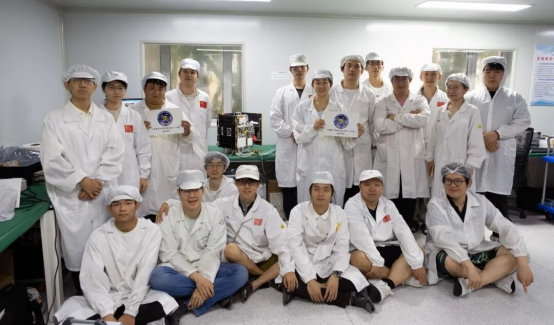
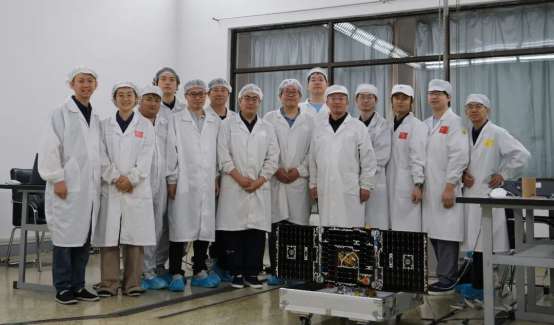
Bayi-04 development team
To inspire young people’s passion for scientific and technological innovation and keep alive their original aspirations and dreams, the team engraved on the satellite’s body
the names of the middle school students who participated throughout the process of addressing key technical challenges in the satellite’s development, so that their names would travel into space with the satellite. The team also entered the names andenrollment aspirations
of all HIT undergraduate students of the Class of 2025 into the satellite’s storage system. These will be dynamically displayed in orbit on the onboard science outreach display, bringing the students’ aerospace dreams into dialogue with the vastness of space and inspiring future generations to carry those dreams forward.
During the satellite’s development, the team worked with the High School Affiliated to HIT to develop and refine a structured aerospace science outreach curriculum built around the actual satellite development process. The curriculum was delivered at the High School Affiliated to HIT and 77 schools in Harbin’s Aerospace Alliance, giving many young people opportunities to engage with aerospace and pursue scientific and technological innovation.
Going forward, the team will continue to use Bayi-04 as a long-term in-orbit platform for a range of activities, including online aerospace learning programs, offline in-orbit measurement activities, space-based science outreach experiments, and aerospace education sessions. The team will fully explore the satellite’s research and educational potential while further developing HIT SOA’s distinctive approach to aerospace education through scientific and technological innovation.
初审:陈东萍
复审:智喜洋
终审:吴洪兴
Address: No. 92, Xidazhi Street, Nangang District, Harbin