


Address: No. 92, Xidazhi Street, Nangang District, Harbin



JOIN-USHIT sincerely invite talents from both home and aproad to join in the new course of constructing first-class universities. |
On September 30, Guangming Daily featured an article titled “The Way of Scholarship Is a Lifelong Faith” on the front page in its “This Is How I Pursue Scholarship” column. The article tells the story of Professor Du Shanyi, a member of the Chinese Academy of Engineering and a faculty member at HIT SOA, who has consistently made national needs his foremost consideration in his academic work. It also recounts his reflections and insights from decades of scholarship, research, and education.
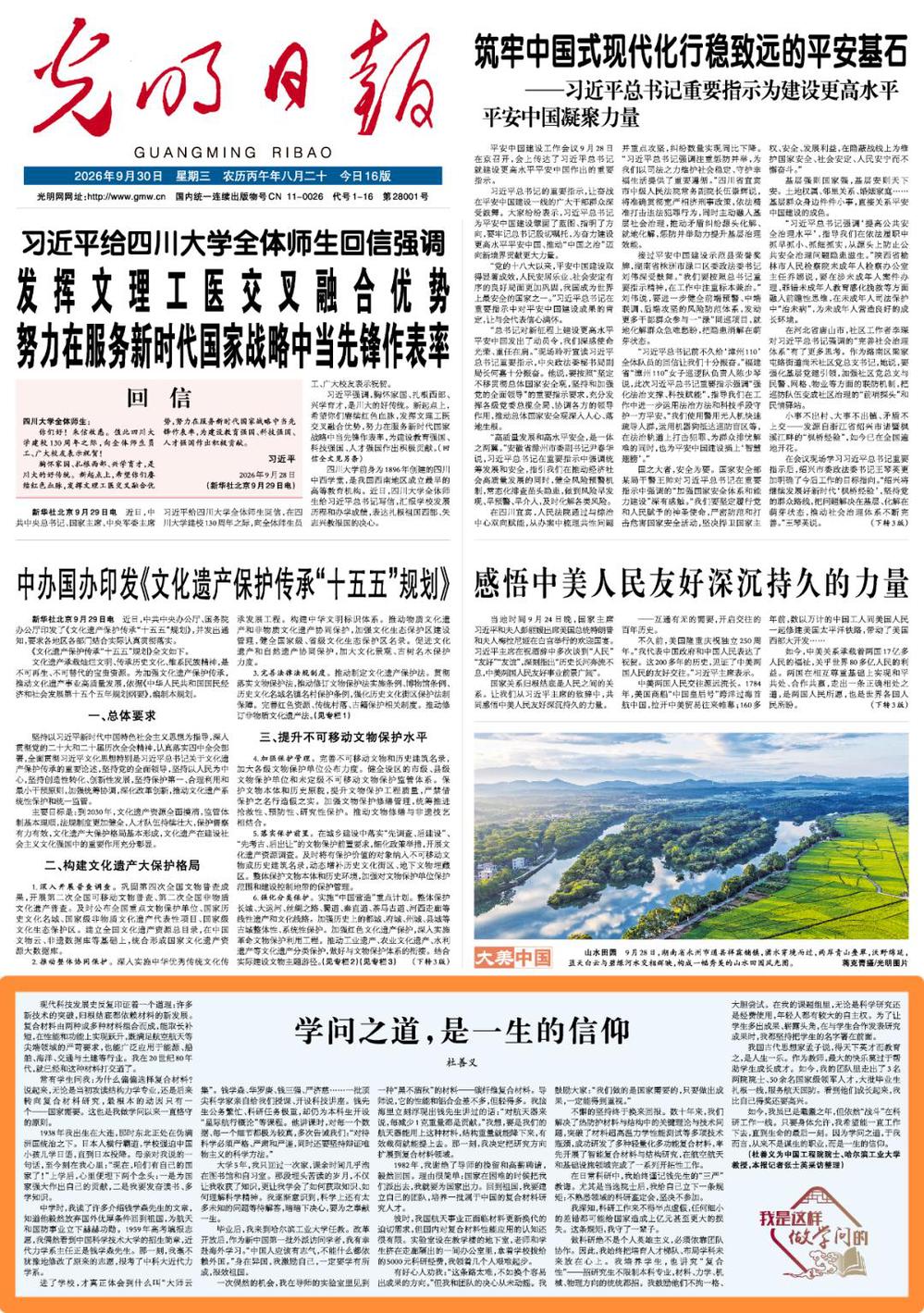
The Way of Scholarship Is a Lifelong Faith
Du Shanyi
The history of modern science and technology has repeatedly demonstrated one fundamental truth: breakthroughs in many new technologies ultimately depend on advances in materials. Composite materials combine two or more materials, drawing on their respective strengths to achieve substantial improvements in performance and functionality. They meet the stringent requirements of advanced fields such as aerospace and also have wide-ranging applications in energy, shipbuilding, marine engineering, transportation, civil engineering, and other sectors. I began working with these materials back in the 1980s.
。
Students often ask me why I chose composite materials in particular. Looking back, whether I was studying structural mechanics as my undergraduate major or later turned to research on composite materials, there was only one fundamental motivation: the needs of my country. This has been the principle I have consistently followed throughout my academic career.
I was born in Dalian in 1938, when Northeast China was under the rule of the Japanese-controlled puppet state of Manchukuo. The Japanese acted with impunity, and schools forced Chinese children to learn Japanese until Japan surrendered. One thing my mother said to me has remained engraved in my memory: “Now we have our own country!” When I started school, two aspirations took root in my mind: to contribute to making our country strong, and to study diligently and acquire as much knowledge as I could.
In middle school, I read many articles about Qian Xuesen and learned that he had given up favorable conditions abroad to return to China, where he made outstanding contributions to the country’s aerospace and national defense programs. In 1959, while filling out my college application preferences, I happened to come across the admissions brochure for the University of Science and Technology of China (USTC). Qian Xuesen himself was the head of its Department of Modern Mechanics. I immediately changed my original choices and applied to the department.
It was only after entering the university thattruly understood what it meant to be surrounded by so many masters. Qian Xuesen, Hua Luogeng, Qian Sanqiang, Yan Jici, and other leading scientists taught our classes and delivered lectures on scientific and technological topics. Despite his demanding responsibilities and heavy research workload, Professor Qian nevertheless taught undergraduates courses such as Introduction to Interstellar Navigation. He insisted on absolute accuracy in every figure and paid close attention to even the smallest details. He repeatedly reminded us: “Scientific work demands discipline, a serious attitude, and rigorous methods, while also requiring a commitment to the scientific method of dialectical materialism.”
After graduation, I joined Harbin Institute of Technology (HIT) as a faculty member. Following the launch of China’s reform and opening-up, I was fortunate to be among the first groups of visiting scholars sent overseas by the People’s Republic of China. “We Chinese must have the determination to stand on our own feet rather than depend on other countries for everything.” While studying abroad, I reminded myself that I had to make the most of the opportunity, acquire valuable knowledge and skills, and put them to use for my country.
One day, I happened to come across a rather unremarkable-looking black material in my advisor’s laboratory: carbon-fiber composite material. My advisor explained that its mechanical properties were comparable to those of aluminum alloys, but that it was much lighter. Professor Qian’s words immediately came to mind: “Every gram saved on a spacecraft makes a difference.” I realized that if our spacecraft could use this material, we could reduce their structural mass and increase the payload capacity。. At that moment, I decided to extend my research to composite materials.
In 1982, I turned down my advisor’s efforts to persuade me to stay, along with an offer of a high salary, and resolutely returned to China. The reason was simple: the country had sent us abroad for further training despite its own difficulties, so I felt it was my duty to serve my country. Back in China, I wanted to establish my own research team and train a new generation of Chinese researchers in composite materials.
At the time, China’s aerospace programs faced an urgent need for more advanced materials, but knowledge of the properties and practical applications of composite materials in China was still limited. We set up our laboratory in the basement of a teaching building. Faculty and students crowded into a small office partitioned off from a corridor. With just 5,000 yuan in university research funding, I led a small team as we struggled to get our work off the ground.
Some people, with the best of intentions, advised me: “This path is too difficult. You’d be better off moving into a research area where it’s easier to produce results.” But my team and I never wavered in our determination. I encouraged them: “We are working on something the country needs. If we can deliver meaningful results, our work will receive the attention and suppor。
Decades of sustained effort eventually yielded results. Over the decades, we resolved key theoretical and technical problems involving thermal-protection materials and structures, overcame several major technical barriers—including those involved in measuring the mechanical properties of materials at ultra-high temperatures—and developed a range of lightweight, multifunctional composite materials. We also pioneered research into smart composite materials and structures andcarried out a series of pioneering work in aerospace and infrastructure.
In my day-to-day research, I have always kept in mind Professor Qian’s emphasis on being strict, serious, and rigorous in scientific work. After I was elected to the Chinese Academy of Engineering, in particular, I made a firm rule for myself: I would never take part in research evaluation panels in areas outside my expertise.
I know that there is no room for dishonesty in scientific research. Even a seemingly minor error could cost the country hundreds of millions of yuan or more. It is a rule I have followed throughout my life.
Scientific research is never a one-person endeavor; it depends on teamwork. I have therefore always focused on training successive generations of researchers and planning for the future development of the discipline. I also value interdisciplinary backgrounds in my students. When recruiting graduate students, I do not limit admissions to particular undergraduate majors; I welcome applicants with backgrounds in materials science, mechanics, mechanical engineering, physics, and related fields. I encourage them to think beyond conventional boundaries and try new approaches. In my research group, younger members have considerable autonomy in their research and in how they use research funds. To give students more opportunities to make research contributions and gain recognition, whenever I publish papers with students, I make a point of listing their names before my own.
The ancient Chinese philosopher Mencius observed that one of life’s greatest joys is to find talented people and educate them. For a teacher, there is no greater joy than helping students grow and realize their potential. Today, three members of my research team have been elected to the Chinese Academy of Sciences or the Chinese Academy of Engineering, and more than 50 have becomenational-level leading talents. Many of our graduates have gone on to work in frontline roles supporting China’s aerospace and national defense programs. Seeing how far they have come gives me greater joy than receiving awards myself.
Although I am now well into old age,I am still “fighting” on the front lines of research. As long as my health allows, I hope to continue working for the rest of my life. For me, scholarship has never been merely a profession or a means of earning a living. It has been a lifelong commitment—a faith that has guided me throughout my life.
初审:陈东萍
复审:智喜洋
终审:吴洪兴
Address: No. 92, Xidazhi Street, Nangang District, Harbin