



Address: No. 92, Xidazhi Street, Nangang District, Harbin



JOIN-USHIT sincerely invite talents from both home and aproad to join in the new course of constructing first-class universities. |
Recently, Professor Ma Yufei’s research group at School of Astronautics, Harbin Institute of Technology (HIT SOA) demonstrated rapid, highly sensitive detection of multiple gases using parallel-heterodyne light-induced thermoelastic spectroscopy (PH-LITES). The findings were published in Light: Science & Applications in a paper titled “High-speed and high-sensitivity multi-gas detection based on parallel heterodyne LITES sensor.”
There is a growing need to detect multiple trace gases simultaneously, rapidly, and with high sensitivity in fields such as research into the origin of life in deep-sea environments, environmental safety monitoring, and the exploration of planets beyond Earth. However, existing laser-spectroscopy methods for detecting multiple gases—including time-division multiplexing, spatial-division multiplexing, and frequency-division multiplexing—have several inherent limitations. These include long scan times, complex system configurations, and incompatibility with detectors that operate at a fixed resonant frequency. Developing a single, compact system capable of detecting multiple gases simultaneously at high speed and with high sensitivity therefore remains a major challenge.
To address these challenges, Professor Ma Yufei’s research group developed a “collaborative signal enhancement architecture” for the physical layer. To overcome weak gas-absorption signals and limited detector responsivity, the team designed and developed two key components: a cylindrical optical multipass cell that produces a dense array of beam spots, and a high-performance, four-tine quartz tuning fork. The compact cell, with a volume of just 102.6 mL, provides an effective optical path length of 38.3 m, thereby strengthening the gas-absorption signal. The team also redesigned the conventional two-tine tuning fork as a four-tine structure and optimized its geometry, producing an output signal 4.34 times as strong as that of commercial tuning forks. At the information layer, the team also developed a “collaborative intelligent processing architecture.” Under parallel heterodyne modulation, laser excitation produces a composite transient thermoelastic response in a single tuning fork. A deep-learning model then processes this composite signal through three stages: feature extraction, attention-based enhancement, and temporal modeling. By disentangling the contributions of individual gases from overlapping spectral features, the model can estimate the concentrations of multiple gases from the output of a single tuning fork. Further experiments showed that, with a scan time of just 4 seconds, the PH-LITES sensor achieved minimum detection limits of 378 ppb for CH₄ and 285 ppb for C₂H₂. The correlation coefficient between predicted and ture concentrations reached 0.998, while the average relative prediction errors were just 8.9% for CH₄ and 5.8% for C₂H₂. Compared with other dual-gas sensing techniques, the PH-LITES sensor offered clear advantages in both detection sensitivity and response speed.
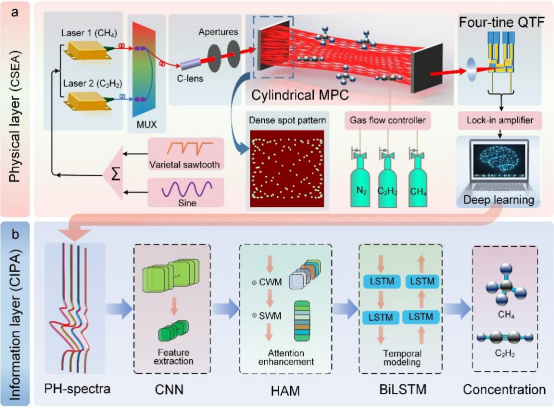
Overall architecture of the PH-LITES sensor: (a) physical layer; (b) information laye
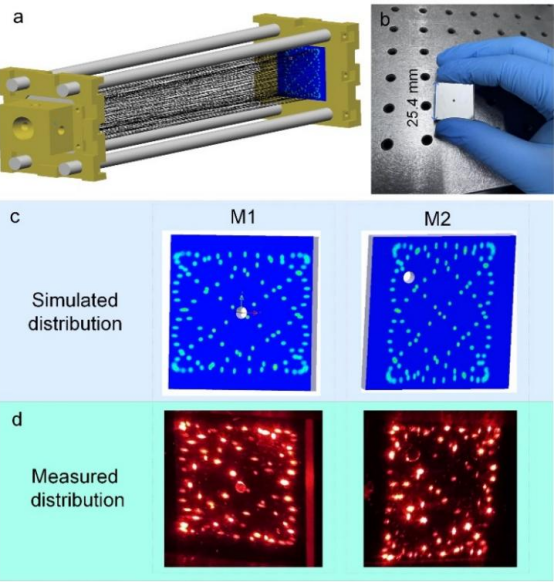
Design of the optical multipass cell with a dense array of beam spots: (a) simulation model; (b) photograph of the cylindrical mirror; (c) simulated beam-spot pattern; (d) experimentally measured beam-spot pattern
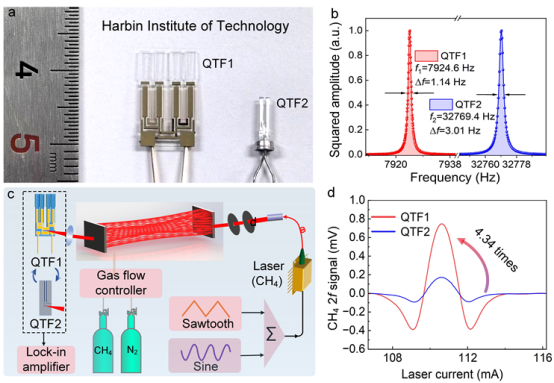
Characterization of the photothermal detection performance of the novel low-frequency, four-tine quartz tuning fork: (a) photograph of the tuning fork; (b) frequency response; (c) experimental setup for performance testing; (d) comparison of output signals
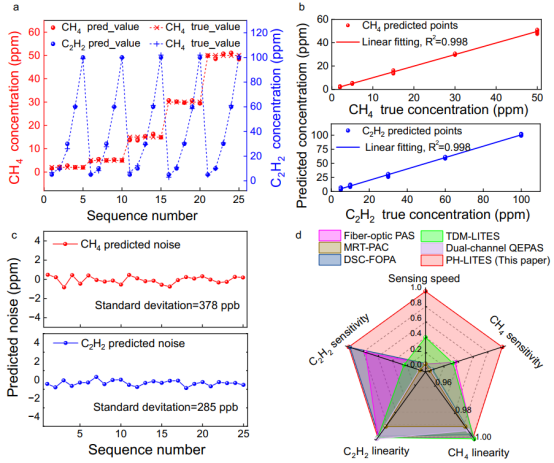
Experimental evaluation of PH-LITES sensing performance: (a) concentration predictions at multiple gas concentrations; (b) linear relationship between predicted and measured concentrations; (c) noise level; (d) performance comparison of different spectroscopic techniques
Professor Ma Yufei is the paper’s sole corresponding author, and PhD student Sun Haiyue is the first author. HIT SOA Professor Dong Yongkang, Associate Professor He Ying, and Associate Researcher Qiao Shunda, together with PhD student Zhang Chu and master’s students Hou Jinfeng and Wang Yuanzhi, contributed to the paper or participated in the related research. The research was supported by a Key Program of the National Natural Science Foundation of China and the HIT Young Scientist Studio, among other sources.
初审:陈东萍
复审:智喜洋
终审:吴洪兴
Address: No. 92, Xidazhi Street, Nangang District, Harbin